Material development for Beyond 5G / 6G — low-loss substrates, radome and cover materials, radio-wave absorbers — requires knowing the complex permittivity in the sub-terahertz bands. Yet conventional VNA-plus-extender measurement becomes prohibitively expensive above 100 GHz, forming a barrier to entry in itself. We are developing "Sub-THz-FDS", a material measurement system based on frequency-domain spectroscopy (FDS) built on our proprietary photonic technology. We have successfully measured dielectric materials in the 300 GHz band (J-band), confirming good agreement with VNA results. Scalable from a few GHz up to about 1 THz — material measurement for the next era.
FDS fills the gap between VNA-based (electronic) methods and THz-TDS (time-domain photonic) methods.
| FDS (ours, in development) | VNA + extenders | THz-TDS | |
|---|---|---|---|
| Principle | Photonics (frequency sweep via optical wavelength sweep) | Electronic (frequency multiplication) | Photonics (femtosecond pulses) |
| Frequency coverage | Scalable from a few GHz to ~1 THz | Separate extender needed per band | Mainly THz region |
| Below 100 GHz | Yes (measurable from ~10 GHz) | Yes | Weak |
| Cost above 100 GHz | Kept low (photonics-based) | Expensive (large R&D investment) | — |
| Setup size | Compact | Tends to be bulky | — |
| Measured quantities | S21 / S11 (complex permittivity extraction) | S21 / S11 | Time waveform → spectrum |
Comparison summarized from our February 2026 press release. The best-suited method depends on application and conditions.
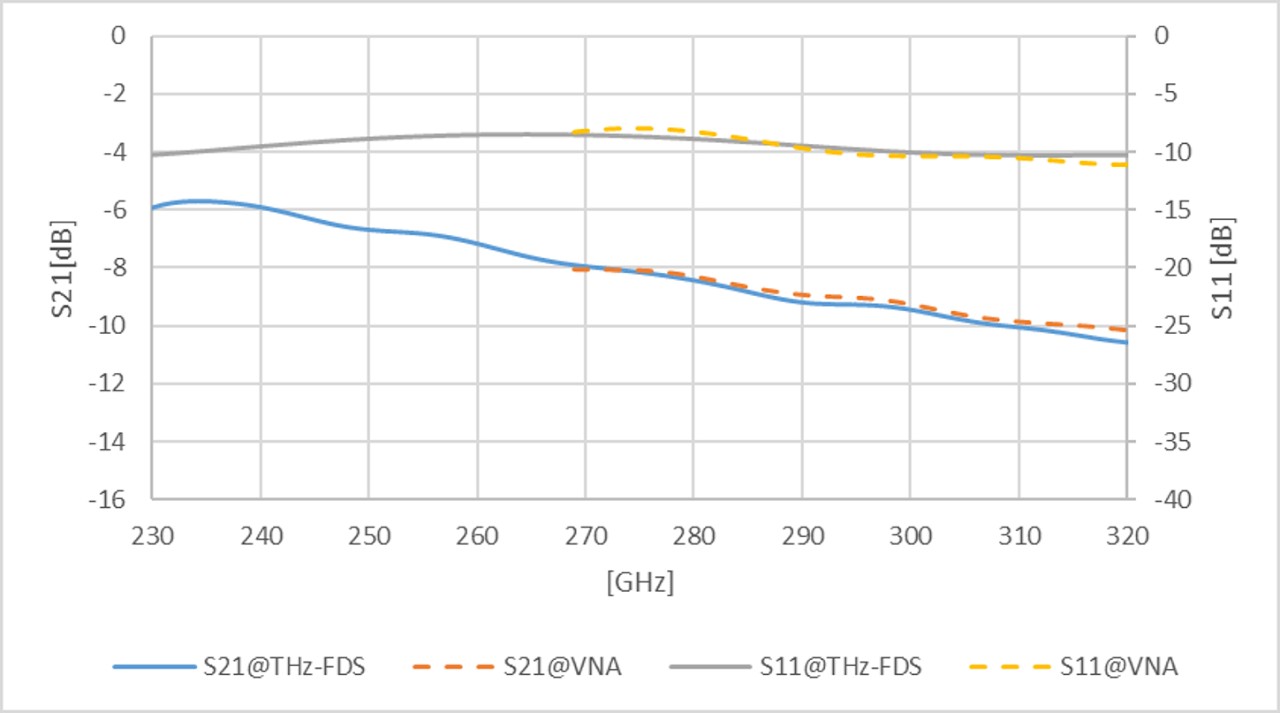
As R&D under Japan's MIC FORWARD program, we demonstrated dielectric material measurement in the 300 GHz band (press release, February 2026).
The system is built on our proprietary photonic technology. Transmission covers the J-band (220–330 GHz), and other bands are supported by swapping the transmitter module. Frequency sweeping is performed by sweeping the optical source wavelength — about 5 seconds across the entire J-band. With compact Tx and Rx units, the measurement layout is highly flexible: mitigating multiple-reflection effects on S11, or setting up custom measurements such as oblique incidence and scattering, is straightforward.
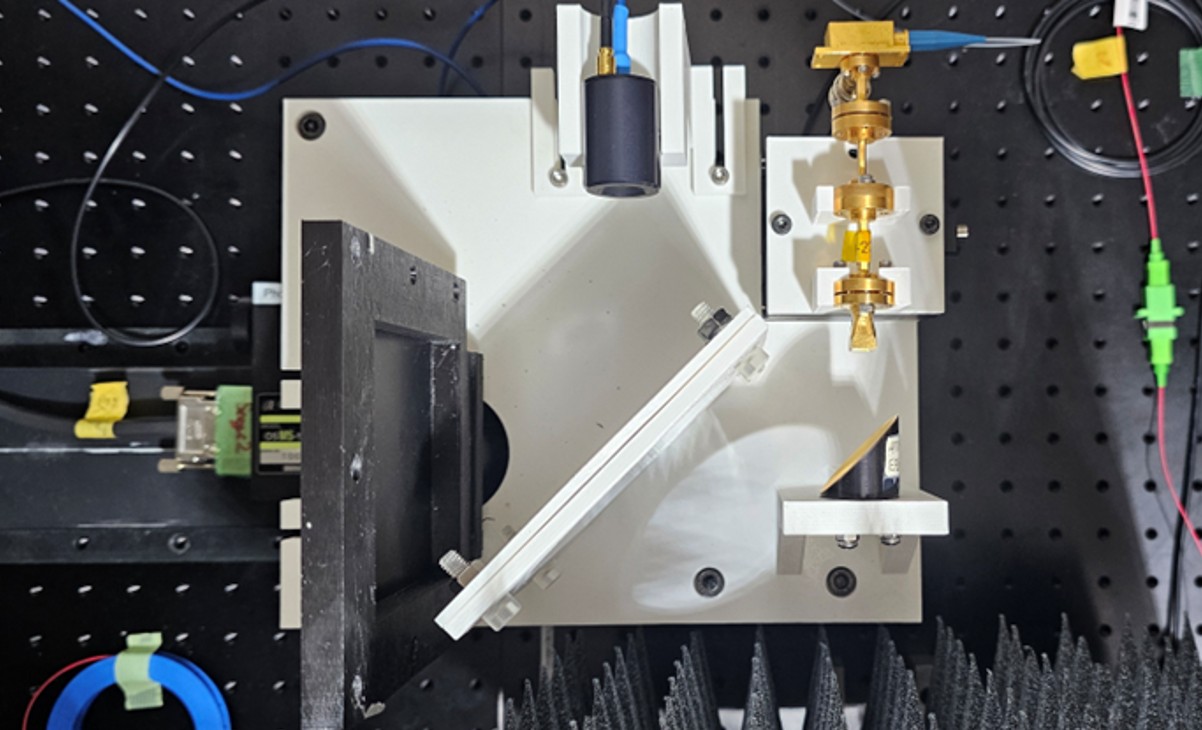
We measured S21 and S11 of dielectric materials in the 300 GHz band and cross-checked the results against VNA measurements. As shown on the right, our system's results (solid lines) agree well with the VNA results (dashed lines).
In progress as R&D under the MIC FORWARD program (FY2024–2026). We welcome early inquiries for evaluation and joint research ahead of productization.
Press release: "Sub-THz material measurement system for 6G established" (February 3, 2026, Japanese) →
Contract R&D, custom measurement instruments, software development, joint research — we work in whatever form suits your project.
Contact Us