Photonic Edge Photonic Edge Inc. 日本語
SolutionsBeyond 5G / 6GElectric-Field Visualization
SOLUTION / MEASUREMENT SERVICE

Electric-Field Visualization

Using our proprietary EO sensor probes, we directly probe the electric field around a device under test and visualize the measured amplitude and phase distribution in space. Covering 1 GHz to 330 GHz — microwave through terahertz — this is a versatile measurement technology: evaluating radar-transparent materials for automotive millimeter-wave radar, characterizing complex reflection/scattering fields such as metasurfaces, and antenna near-field measurement. Available as systems or as a contract measurement service, to suit your situation.

Measured amplitude & phase maps1 GHz – 330 GHz (up to THz)System sales / contract measurement
01

What Is Electric-Field Visualization?

01

Measured amplitude and phase distributions, made visible

We probe the electric field in the space around an antenna or device and acquire amplitude and phase distributions as maps. Because you obtain the same kind of field information as a simulation — but from the real object — you can directly confirm where and how the radio wave propagates. It excels at problems that are difficult to solve in simulation, and at evaluating complex reflection and scattering fields.
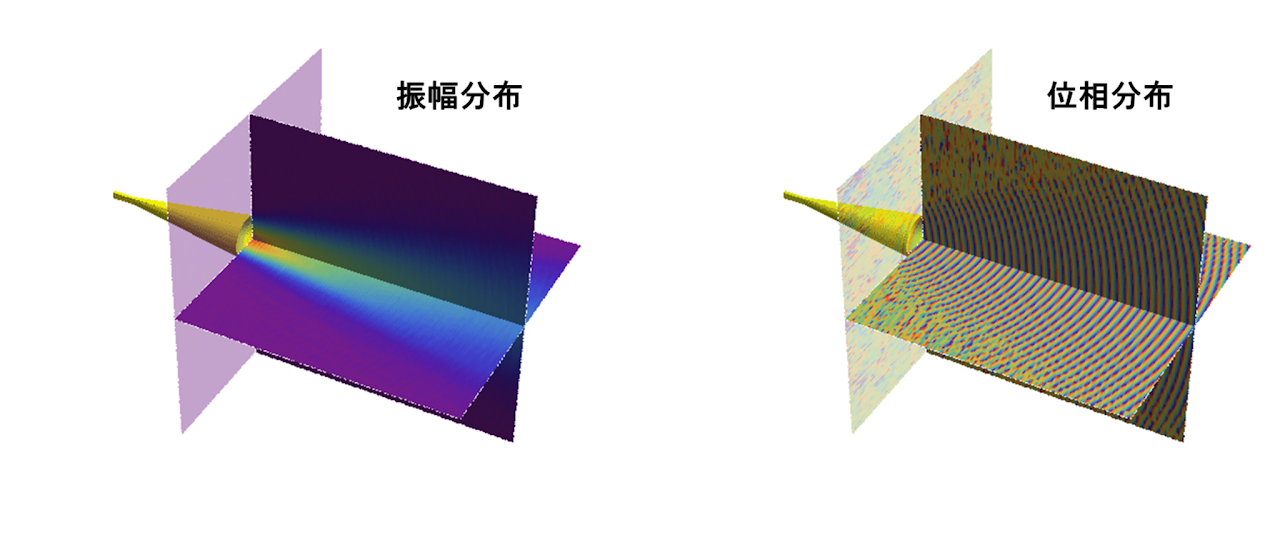
3D visualization of the field radiated from a horn antenna: amplitude (left) and phase (right) distributions
Visualization of a horn-antenna radiation field. Amplitude (left) and phase (right) obtained as spatial maps.
02

Ultra-low-invasive probing with proprietary EO sensor probes

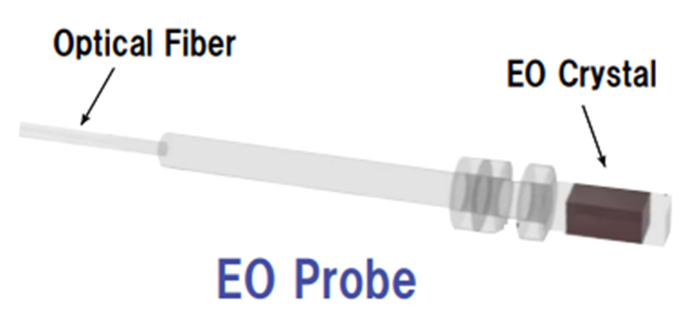
The probe element is an EO (nonlinear optical) crystal. Being a small, metal-free, fiber-optic probe, it probes the field while barely disturbing it, enabling low-invasive measurement up to several hundred GHz.
  • Measurable wherever the probe can physically reach
  • Directly measures not only transmitted fields but reflected fields
  • Low disturbance keeps near-field-to-far-field computation accurate
Structure of the EO sensor probe: a metal-free micro probe with an EO crystal on an optical fiber tip
Structure of the EO sensor probe: an EO crystal on the tip of an optical fiber (metal-free).
Tx antenna Incident wave DUT (cover material, reflector, etc.) EO probe (transmitted field) EO probe (reflected field) Reflection EO measurement system Detects amplitude & phase Optical fiber (metal-free) The small metal-free probe barely disturbs the field, giving accurate amplitude/phase maps even near the DUT.

Concept of field measurement with EO sensor probes

03

Microwave through terahertz (1 GHz – 330 GHz)

The technique is not tied to any particular band. Automotive radar bands (76–81 GHz), the 28 GHz band used for 5G/6G and metasurfaces, and terahertz applications — all can be visualized within the same framework.

1GHz 10GHz 100GHz 330GHz 5G / metasurface 28GHz Automotive radar 76–81GHz Terahertz Coverage: 1 GHz – 330 GHz

Supported frequency range

02

Examples & Applications

01

Cross-checking with simulation

The figure shows the aperture of a 76.5 GHz gain horn antenna, measured and compared with simulation. Even at millimeter-wave frequencies, measurement yields the same field information (amplitude and phase) as simulation. Cross-checking basic conditions between measurement and simulation raises confidence when analyzing complex fields, and can be used to improve the accuracy of the analysis itself.
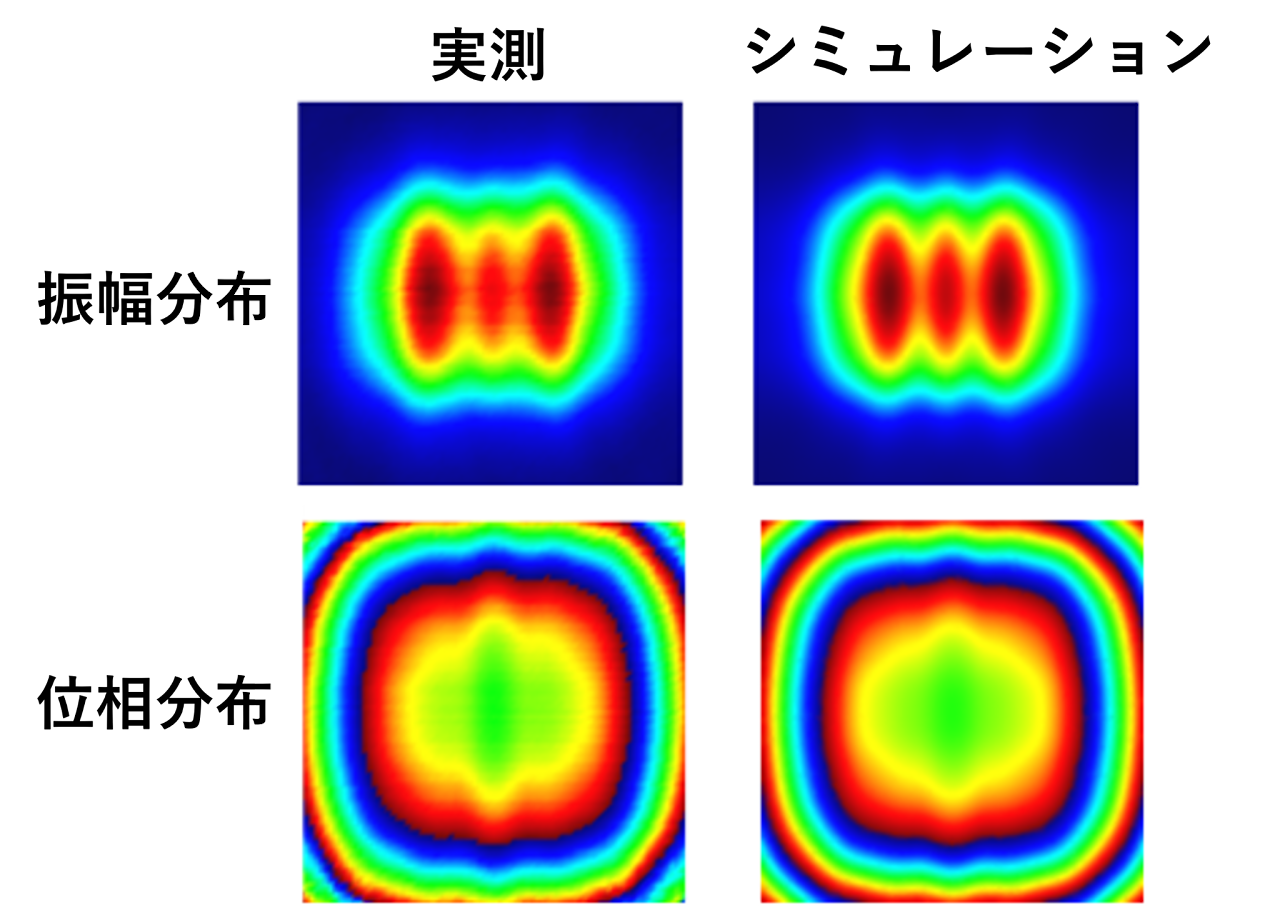
Amplitude/phase distributions over a 76.5 GHz gain horn aperture: measurement vs. simulation
76.5 GHz gain horn aperture: measurement (left) vs. simulation (right). Amplitude and phase both agree well.
02

Complex reflection and scattering fields — e.g. metasurface reflectors

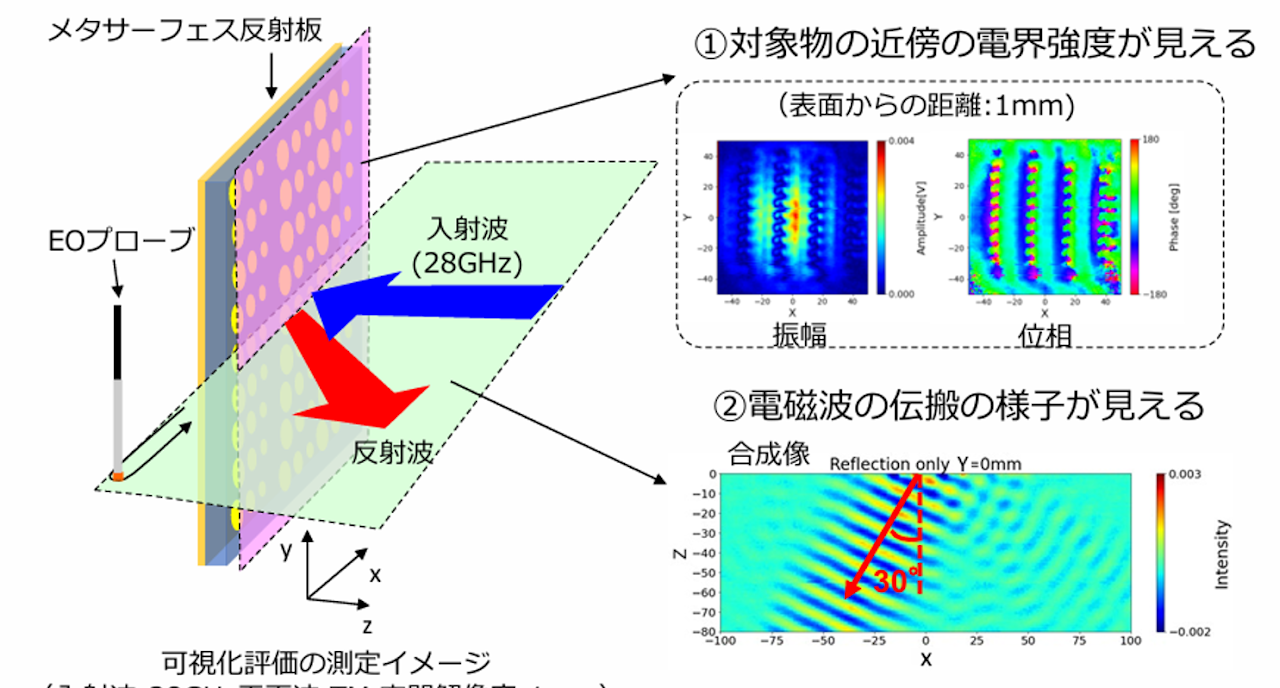
The figure shows measurement of a 28 GHz-band metasurface reflector, designed for anomalous reflection: here the wave reflects 30° away from the specular direction. Both the field strength (amplitude/phase) near the object and the wave propagating away are visible in measurement, so you can confirm at what angle and how strongly the wave actually reflects — an ideal tool for design evaluation and feedback.
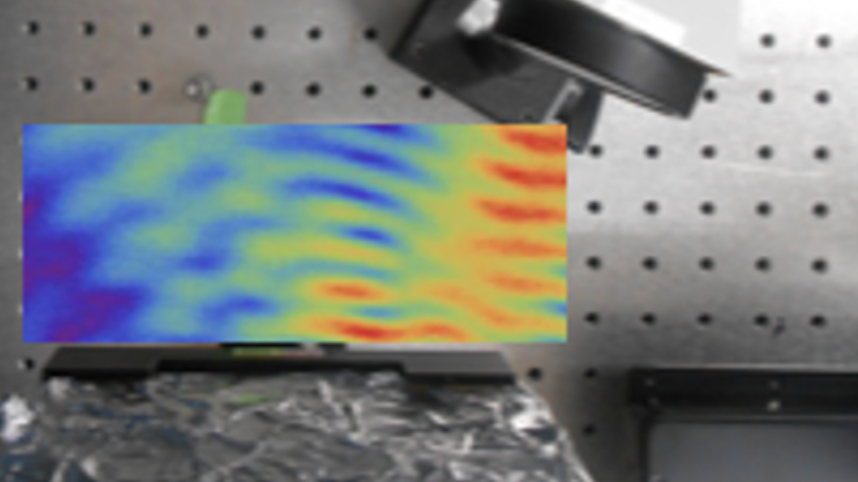
Scattered field around an irregular reflecting surface, visualized and overlaid on a photo of the setup
A complex reflection/scattering example. Fields disturbed by an irregular reflector are visualized as they are.
Measurement of a 28 GHz metasurface reflector: near-field strength and the wave propagating toward 30 degrees
28 GHz metasurface reflector: (1) field strength near the object and (2) the wave reflecting and propagating toward 30° — both confirmed by measurement.
03

Field disturbance by radar-transparent materials

Field disturbance and leakage behind radomes, emblems, and bumpers can be visualized directly at the field level. Use it to assess whether a cover material could cause radar angle errors, or to pinpoint the cause of anomalies found in radar performance evaluation or dielectric characterization.
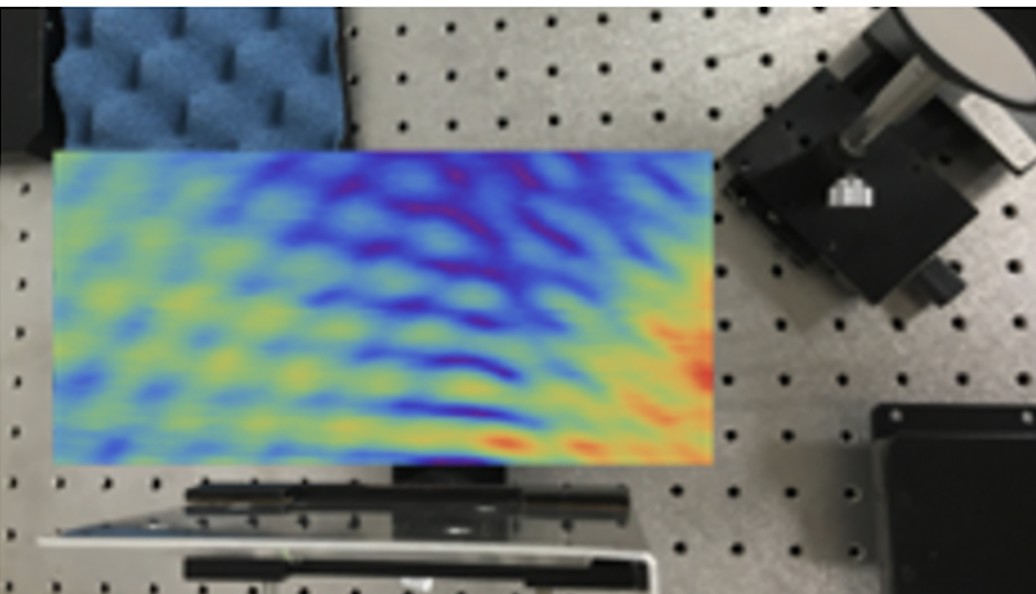
Measured field distribution overlaid on a photo of the measurement setup
Measured field overlaid on a photo of the setup. Unexpected disturbance and leakage locations are visible at a glance.
04

Application: antenna near-field measurement

The low-invasive EO sensor probe is also suited to measuring fields close to antennas. Since amplitude and phase are acquired without disturbing the near field, near-field-to-far-field transformation is computed correctly, extending the technique to radiation-pattern evaluation.
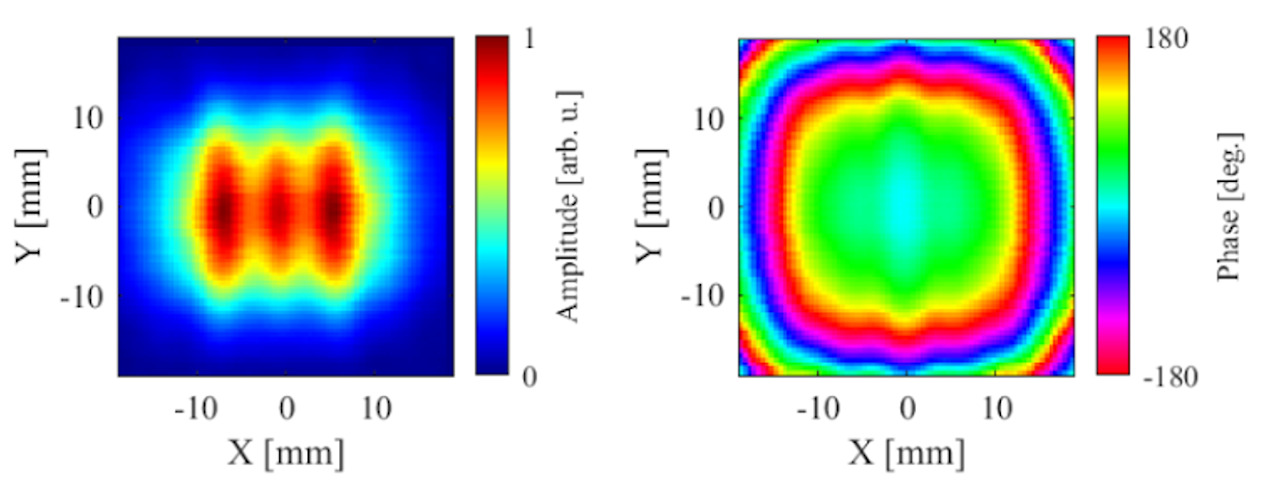
Measured amplitude and phase distributions near an antenna aperture
Amplitude (left) and phase (right) distributions measured near an antenna aperture.
03

How We Deliver

System sales, contract measurement, and more — we adapt to your situation.

  • Contract measurement (send us your samples, or witness the measurement at our site)
  • Construction and delivery of evaluation systems including instruments and fixtures
  • Early-stage feasibility studies ("can this be sensed at all?")

Talk to us about anything high-frequency.

Contract R&D, custom measurement instruments, software development, joint research — we work in whatever form suits your project.

Contact Us